October 15th, 2026
WHAT WE SHARE – Design Research on Space and Coexistence (Exhibition)
How do we share space when different interests, needs, and ways of life intersect? Democracy does not take place solely within political institutions. It also emerges wherever people come together and negotiate how they want to live. Public squares, streets, buildings, and other spaces of everyday life are also spaces of democratic practice — places where communities take shape (Bieling et al. 2025a), differences become visible, and the terms of living together are (re-)defined.
Yet these spaces cannot be taken for granted. Digitalisation, privatisation and commercialisation are transforming where and how we encounter one another. At the same time, we share our environment not only with other human beings, but also with animals, plants, microorganisms and technological systems. What does it mean to share space? Who or what is allowed to belong? And how can we develop ways of living together that take different interests into account and enable new forms of connection?
The exhibition “WAS WIR TEILEN” (WHAT WE SHARE), curated by Tom Bieling and Susanne Wieland, brings together projects by students at the Offenbach University of Art and Design (HfG Offenbach), developed within the teaching field Design Theory and Research. Approaching these questions through design-based research, the projects invite us to challenge familiar perspectives and understand sharing as a collective endeavour (Bieling et al. 2025b): an opportunity to explore common ground, take responsibility, and experiment with new forms of coexistence.
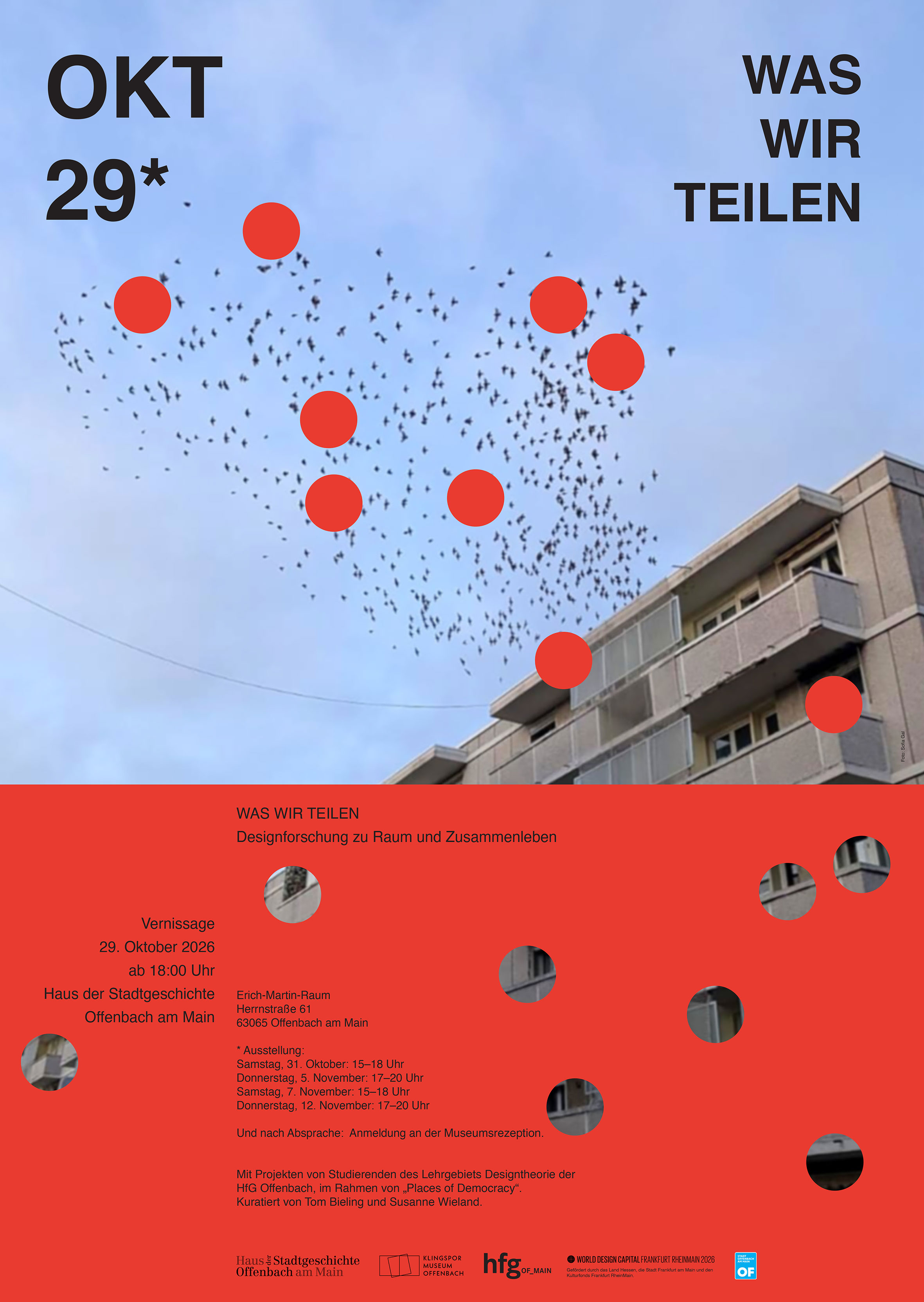 Plakat: Wieland, Foto: Sofia Gal.
The exhibition features work from the following seminars: Democracy as Space — On the Topology of Democratic Practice; Gegenentwürfe — The Politics of Design; Sympoietic Design — Designing Coexistence; Pro and Contra — Design as Debate; and Design and Community. It also includes diploma projects, BA and MA theses from the teaching area Design Theory and Research (Prof. Dr. Tom Bieling).
WAS WIR TEILEN – Designforschung zu Raum und Zusammenleben
(WHAT WE SHARE – Design Research on Space and Coexistence)
Opening reception: Thursday, 29 October, 6 pm
Exhibition: 30 October – 12 November
Haus der Stadtgeschichte, Offenbach
Erich Martin Raum, Graphic Collection
Herrnstraße 61, Entrance B, 2nd floor
Featuring work by: Fabian Arnold, Franka Bahlke, Noa Becker, Yasmine Ben Moussa, Paul Berger, Anton Birke, Christopher Bischoff, Devin Can, Xenia Christoph, Mi Düver, Kosmas Ftoulis, Sofia Gal, Lukas Gall, Simon Hanke, Fritz Held, Hannah Heruday, Antonia Hinderegger, Gerrit Hülsmann, Fionn Husemann, Alexej Kosin, Lukas Lange, Lennard Ludig, Clara Maldener, David Martin Maurer-Laube, Zachary Mentzos, Mark Mittasch, Fuheng Nan, Marie-Josefine Pavesi, Svea Marlen Rauch, Lorenz Recken, Simon Schmidt-Meinzer, Mia Schreiber, Carola Schulz, Sallar Shayegan, Anna Stashko, Jean-Luc Klaukien, Anna Koitschev, and Konstantin Illi.
The exhibition is presented as part of the WDC project “Places of Democracy / Orte der Demokratie” (initiated by Astrid Jäger and Monika Jäger in collaboration with the Klingspormuseum and Haus der Stadtgeschichte), supported by the State of Hesse, the City of Frankfurt am Main, and the Kulturfonds Frankfurt RheinMain.
References
Bieling, T., Jonas, W. and Loschiavo dos Santos, M.C. (Eds.) (2025a): Community (&) Design: Material, Spatial, and Social Encounters. Mimesis International.
Bieling, T., Brandes, U., Christensen, M. and Jonas, W. (Eds.) (2025b): Nutzen statt Besitzen: Michael Erlhoff Revisited. BIRD Board of International Research in Design, Basel: Birkhäuser.