October 24th, 2026
From Historic Manufactory to a Laboratory for the Future
Founded in 1746, the Höchster Porzellan-Manufaktur (HPM) has a history shaped by craftsmanship, artistic innovation and repeated transformation. As the second-oldest porcelain manufactory in Germany, it has played an important role in the country’s ceramic heritage. Today, HPM is entering a new chapter: since 2023, it has been part of the Hochschule für Gestaltung Offenbach (HfG) as a teaching and research site, where traditional production knowledge meets contemporary art, design and material research.
On 24 October 2026, HPM celebrates its 280th anniversary with a Tag der offenen Manufaktur. Visitors will have the opportunity to explore the manufactory’s history, discover current projects by HfG students and experience how a historic production site is being reimagined as a space for experimentation and research.
From Historic Manufactory to Contemporary Research Site
The story of HPM began when the Mainz Elector and Archbishop Johann Friedrich Karl von Ostein granted the founding privilege for a porcelain manufactory in Höchst in 1746. In the following decades, it developed into an important centre of European porcelain production. Among the artists associated with its early history was Johann Peter Melchior, who became model master in 1766 and created figurative designs that remain central to the manufactory’s artistic legacy.
The manufactory’s history was not without interruption. Political upheavals during the French Revolutionary Wars brought production to an end, and HPM was officially dissolved in 1796. Its legacy nevertheless survived through historical figures, moulds and designs. Production resumed in 1947, and the manufactory continued to evolve over the following decades, combining its historical identity with contemporary design.
A fundamental change came in 2023, when the HfG Offenbach took over the manufactory under a new concept. The aim is no longer simply to preserve a traditional production process, but to develop HPM as an interdisciplinary environment for teaching, research and artistic practice. Its historical moulds, tools, production facilities and specialist knowledge provide a unique foundation for exploring how established craftsmanship can inform new approaches to materials and manufacturing.
At the heart of this approach is the conviction that heritage and innovation are not opposites. Traditional porcelain production involves highly specialised knowledge of modelling, mould-making, casting, firing and surface finishing. Much of this knowledge is acquired through practice and experience. By preserving these skills while connecting them with digital manufacturing, ceramic 3D printing, robotics and experimental design methods, HPM creates opportunities for new forms of research. Its archive, too, becomes more than a repository of historical objects: it provides a starting point for investigating materials, techniques and forms across different periods.
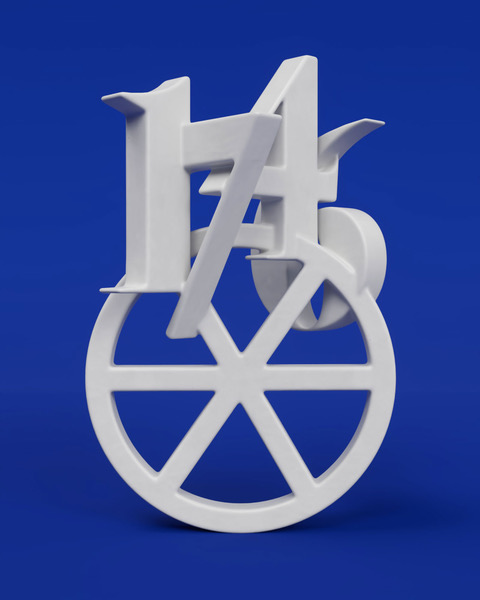 HPM 1746 (Entwurf: Timo Lenzen).
Material Research, Artistic Practice and New Possibilities
Two complementary approaches to this work are represented by the Institute for Material Design (IMD), headed by Prof. Dr. Markus Holzbach, and the Ceramic Art Lab (CAL), led by artist and educator Merja Herzog-Hellstén.
Holzbach, Professor of Material Design at the HfG Offenbach since 2009, investigates the relationship between materials, form and manufacturing processes. At the Institute for Material Design, material is understood not simply as a resource to be shaped, but as an active part of the design process. The institute combines analogue craftsmanship with digital methods and explores how material properties, structures and technical possibilities can generate new forms. At HPM, this approach opens up a dialogue between the precision and experience of traditional porcelain production and emerging technologies, making material design an important part of the manufactory’s research activities.
The Ceramic Art Lab, led by Merja Herzog-Hellstén, approaches ceramics from an artistic and spatial perspective. A Finnish-born artist, curator and educator, Herzog-Hellstén has taught at the HfG since 2017. Her practice includes concept-based mixed-media installations and site-specific sculptures, exploring the relationship between material, object and space. At CAL, students from Art and Design experiment with ceramic materials, surfaces, sculptural forms and different production techniques. Ceramics becomes not only a craft or a means of creating functional objects, but also a medium for artistic inquiry and conceptual expression.
Together, the IMD and CAL demonstrate the breadth of HPM’s contemporary identity. While Holzbach’s work focuses on material research, form and manufacturing, Herzog-Hellstén explores the artistic and spatial potential of ceramics. Both approaches rely on experimentation and direct engagement with materials. Their proximity to the manufactory’s production facilities enables students, artists, designers and researchers to work alongside experienced specialists, bringing different forms of knowledge into dialogue.
The international HPM Residency Programme extends this approach beyond the university. Supported by the Aventis Foundation and the Crespo Foundation, the programme invites artists to engage intensively with porcelain and explore its possibilities at the intersection of art, technology and material culture. Access to the manufactory’s facilities and specialist expertise allows residents to develop experimental projects while contributing new perspectives to HPM’s evolving research environment.
The 280th anniversary therefore marks more than a milestone in the history of a historic manufactory. It highlights a transformation in which historical craftsmanship becomes a resource for contemporary research and creative practice. HPM is increasingly a place where knowledge is preserved by putting it to work — through experimentation, collaboration and the development of new approaches to materials and production.
Open Manufactory Day: 24 October 2026
The Tag der offenen Manufaktur offers visitors a chance to experience this transformation first-hand. From 11 am to 6 pm, exhibitions will present work from the Institute for Material Design, the Ceramic Art Lab and the HPM Residency Programme. The displays bring together designs, concepts, artistic ceramics and experimental projects, offering insights into the different ways in which porcelain and other materials can be explored today.
Guided tours at 12 noon and 3 pm will take visitors through 28 stations spanning 280 years of HPM history. They will offer insights into processes such as model and mould making, archiving, modelling, painting and firing. At 2 pm, historian Konstantin Lannert, curator of the new Bolongaro Museum, will give a lecture exploring HPM’s history through selected objects.
After 280 years, the story of Höchst porcelain is far from finished. Its future lies in the productive encounter between historical knowledge and new ideas, between craftsmanship and technology, and between art and research. By bringing these fields together, HPM is transforming its heritage into a living resource for the next generation of makers, artists and researchers.
Tag der offenen Manufaktur
24 October 2026, 11 am–6 pm
Höchster Porzellan-Manufaktur (HPM)
Palleskestraße 32, 65929 Frankfurt-Höchst, Germany
References
Holzbach, Markus & Tom Bieling: Material (&) Design – Research through Materialdesign. Mimesis International, Milano. [in print / to be published in Winter 2026]