January 19th, 2026
re–design democracy: Rethinking Democratic Futures Through Design
Around the world, the state of democracy gives cause for deep concern. Free elections, an independent judiciary, and a free press—once considered the pillars of democratic societies—often lose their meaning when market forces turn them into commodities available to the highest bidder, as Arundhati Roy has sharply observed. Yet despite this disillusionment, withdrawal is not an option. Instead, the urgent task is to reclaim the fundamental concepts of democracy, to rethink them in relation to today’s pressing political challenges, and to pluralise them for diverse societies.
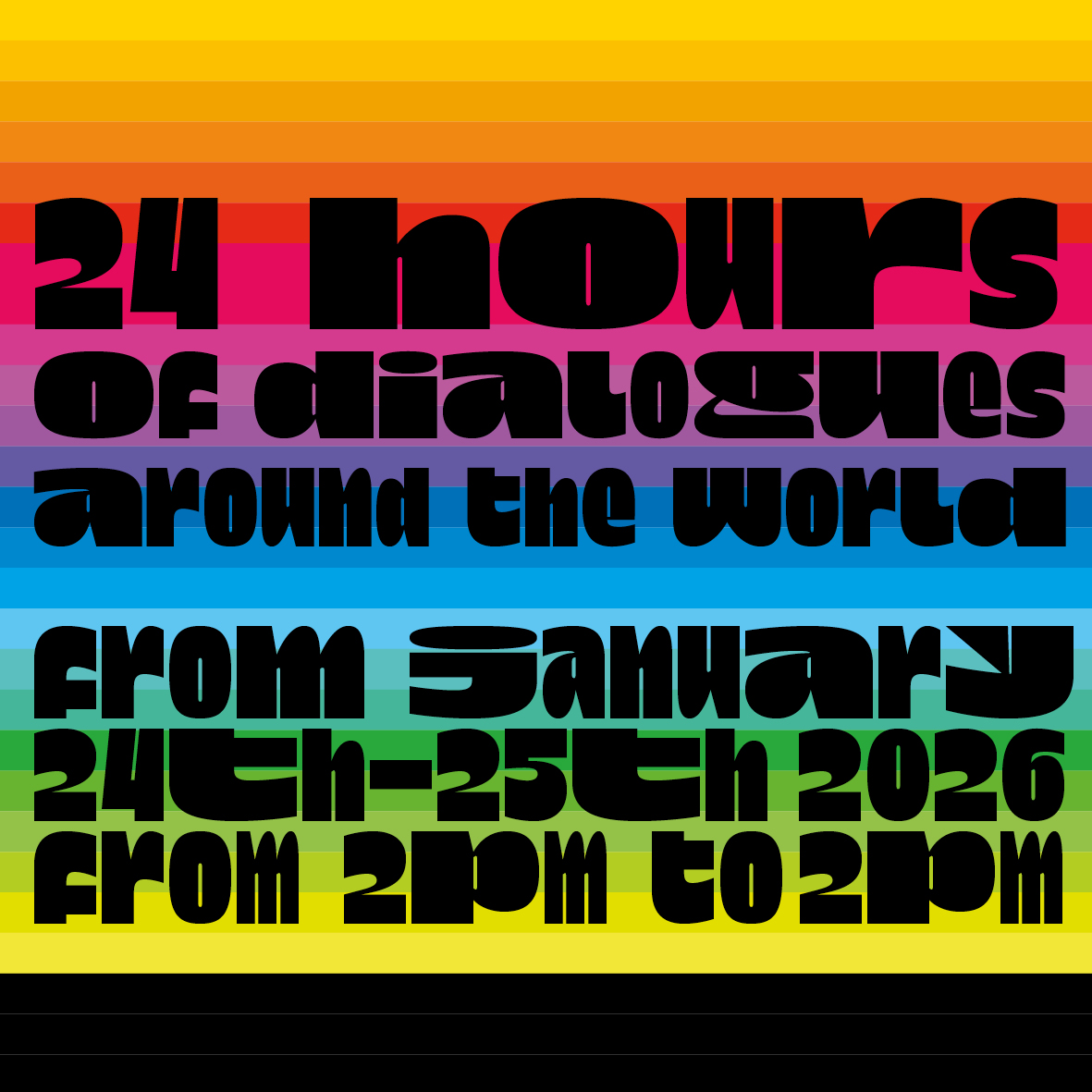
Against this backdrop, Civic City is hosting the 24-hour international conference “re_Design Democracies”, bringing together 96 voices from around the world to discuss the present and future relationship between design and democracy. The conference takes place across time zones and locations, with live studios in Frankfurt and Saint-Étienne, and is embedded in Civic City’s 8th Design Night, held on 24 and 25 January.
The programme begins on 24 January at 10 a.m. with a festival at the MAK in Frankfurt and simultaneously at design schools worldwide. This opening event presents the first contributions to the series “1000 Statements on Democracies”, featuring free, personal reflections on democracy by young authors, who will accompany and discuss their statements on site.
At 2 p.m., the 24-hour live broadcast “re_Design Democracies” begins. Over the course of a full day, each of the 96 invited speakers will be interviewed for 15 minutes by Ruedi and Vera Baur, Christopher Dell, and Danielle Rosales. Following the rhythm of global time zones, the broadcast amplifies perspectives from different cultural and political contexts, creating a continuous global conversation on the condition and future of democracy. The first hours will take place in publicly accessible studios at the MAK in Frankfurt and at the Cité du Design in Saint-Étienne. The entire broadcast can also be followed remotely.
On 25 January 2025 Tom Bieling will talk about “Exploring Open Dialogue Spaces as Tools for Democratic Community Empowerment.”, also presenting the project SPEAK UP, which responds directly to the shrinking number of spaces for public dialogue in contemporary democracies.
SPEAK UP
The starting point of SPEAK UP (Maurer-Laube/Mentzos/Bieling 2026) is political scientist Rainald Manthe’s thesis that democracy is increasingly losing places where societal dialogue can take place. In times of growing social tensions, visible and accessible spaces for exchange and disagreement are more necessary than ever. SPEAK UP is a mobile Speakers’ Corner—a symbol of free speech, public participation, and open exchange—that can be flexibly installed in a wide range of locations: public squares, parks, schoolyards, in front of city halls, or at demonstrations.
Inspired by the historical tradition of Speakers’ Corner, the project offers a low-threshold opportunity for people to take a public stand, listen to others, and engage in dialogue—regardless of background, education, or political views. By encouraging encounters between neighbours, schools, cultural initiatives, and civic organisations, SPEAK UP strengthens local connections and social cohesion through shared participation. The structure is easy to handle, quick to assemble and disassemble, yet robust enough for public use. It goes precisely where democratic dialogue is often missing—direct, approachable, and accessible.

As an open-source project, SPEAK UP makes its construction plans freely available. Anyone can build their own SPEAK UP for use in schools, community groups, cultural projects, neighbourhoods, or municipalities. In this way, the idea of lived democracy spreads tangibly through public spaces and everyday life.
With re_Design Democracies, Civic City creates a platform that does not merely analyse the crisis of democracy, but actively explores how design can contribute to renewing democratic practices—by shaping spaces, formats, and tools for dialogue, participation, and collective imagination. The format takes place in the context of WDC World Design Capital 2026, contributing to the broader international programme that explores how design can address societal challenges and strengthen democratic cultures. As part of WDC 2026, re_Design Democracies positions design as a critical practice for civic engagement, participation, and the renewal of democratic spaces.
The broadcast will be transmitted in the form of podcasts via:
1000 Declarations on Democracies
10:00 a.m. – 1:00 p.m. (Paris time)
https://youtube.com/live/5FTjs8p7LR0?feature=share
24h re_design democracies
January 24, 2:00 p.m. – 12:00 a.m. (Paris time)
https://youtube.com/live/F1j7ykOXJC0?feature=share
24h re_design democracies
January 25, 12:00 a.m. – 2:00 p.m. (Paris time)
https://youtube.com/live/DUInMR7a-y4?feature=share
Information and transcription:
https://civic-city.org/24hours
Programme
24.01.26 – 2:00–3:00 p.m.
Introduction from the studios in Saint-Étienne and Frankfurt
2:00 p.m. – Brief introduction to the ninth broadcast of “24 Hours Around the World”:
Civic City, Ruedi Baur, Vera Baur, Christopher Dell.
2:15 p.m. – Presentation of World Design Capital Frankfurt RheinMain 2026:
Barbara Lersch, Program Director;
Kai Rosenstein, Director of Scenography;
Johannes Deuter, Head of Graphic Design, Museum für Angewandte Kunst, Frankfurt.
2:30 p.m. – Presentation of the Cité du Design, Saint-Étienne:
Éric Jourdan, Director of the Cité du Design and the School of Art and Design;
Aurélie Volz, Director of the Museum of Modern Art, Saint-Étienne.
2:45 p.m. – Introduction to the theme “Redesign Democracies”:
Civic City, Ruedi Baur, Vera Baur, Christopher Dell.
24.01.26 – 3:00–4:15 p.m.
Revisiting the historical foundations of democracy
If we affirm today that democracy originated in the Greek polis, to what extent did slavery— which was a prerequisite for its development—contribute to shaping part of our history, in ways that persist into our most extreme modernity?
3:00 p.m. – Paulin Ismard, historian specializing in ancient history. In 2021, he edited “The Worlds of Slavery: A Comparative History” (Éditions du Seuil).
Analysis of the global state of democracy
Driven by migration, demography, and the question of citizens’ political effectiveness, a renewed debate on the political influence of cities has recently emerged. What role does the territorial scale of governance play in the practice of democracy? What tensions arise when the nation-state exerts excessive power over local spaces?
3:15 p.m. – Benoît Vallauri, Director of Partnerships, Territories, and Innovation (DiPTI), National Center for Territorial Civil Service.
3:30 p.m. – Emanuel Grégoire, First Deputy Mayor of Paris.
3:45 p.m. – Jean Baudoin in discussion with the Mayor of Montreal or other mayors of major cities (to be confirmed).
24.01.26 – 4:15–4:45 p.m.
Shifts and turning points
If history does not repeat itself, it nevertheless seems essential to consider the past in order to understand and anticipate the present. During the darkest hours of the last century, what attitudes were adopted by institutional leaders, by creators, and by the avant-gardes? What shifts or turning points occurred?
4:15 p.m. – Xavier de Jarcy, journalist and author of “Le fascisme en col blanc” and “Le Corbusier: A French Fascism.”
All constitutions of modern democracies, deeply shaped by the issue of fundamental rights, rest upon elements of exclusion. They intrinsically define who holds rights and in what manner, and who is excluded as a subject of rights. What happens, then, when norms of rights and responsibilities—invoking, for example, the universality of human rights and capable of challenging topographical power—are themselves shaped by the configurations of that very power?
4:30 p.m. – Ranabir Samaddar, Indian political scientist, Chair in Migration and Forced Migration Studies at Mahanirban Calcutta; author of “The Materiality of Politics” (Anthem Press, 2007).
24.01.26 – 4:45–6:00 p.m.
Democracy, bodies, and health / Queer-feminist perspectives
4:45 p.m. – A discussion with Capucine Legelle, journalist and activist.
5:45 p.m. – Margarita Tsomou, Greek scholar based in Berlin, activist, dramaturg, moderator, and curator.
24.01.26 – 6:00–7:00 p.m.
Kuwait / Ukraine / Gaza / Venezuela / Taiwan / Greenland
On August 2, 1990, Iraqi troops entered Kuwaiti territory. On the same day, the United Nations adopted Resolution 660 condemning the invasion and demanding the withdrawal of these troops. On August 6, through Resolution 661, it decided to impose an embargo on Iraq…
The inviolability of territory is stated in Article 2 of the Charter of the United Nations, which requires States to “refrain (…) from the threat or use of force (…) against the territorial integrity.” A second principle, the non-recognition of the acquisition of territory by force, dates back to UN General Assembly Resolution 2625 (1970), which specifies that “no territorial acquisition resulting from the threat or use of force shall be recognized as legal.”
This reflects the ancient principle of Roman law ex injuria non oritur, meaning that an illegal acquisition cannot be legitimized.
6:00 p.m. – Philippe Rekacewicz, French cartographer, geographer, and information designer.
On the processes of map-making that contribute to the construction of a “national cartographic narrative.” Co-author of Radical Cartography: Explorations (Éditions La Découverte, 2021).
6:15 p.m. – Amélie Férey, researcher at the Center for Security Studies and Head of the Defense Research Laboratory (LRD). Author of Words as Weapons in a New War (Éditions Le Robert, 2024).
6:30 p.m. – Mohamed Harb, painter, Gaza;
Christine Breton, Honorary Heritage Curator. In collaboration with the Council of Europe, she has, since 1995, experimented with residents on an integrated approach to heritage in the 15th and 16th districts of Marseille. Her most recent book: But What Were They So Afraid Of? W. Benjamin, E. Bloch and S. Kracauer in Marseille on September 8, 1926 (Éditions Commune, 2023).
24.01.26 – 7:00–8:00 p.m.
Constitution / Languages / Signs / Theatre
7:00 p.m. – Barbara Cassin, philologist, Hellenist, and French philosopher, member of the Académie française. Latest book: The War of Words (Flammarion, 2025).
“Trump and Putin each invent their own Newspeak. And I am afraid that one day we will no longer be able to say: this is a lie.”
7:15 p.m. – Philippe-Joseph Salazar, Emeritus Distinguished Professor, Faculty of Law, University of Cape Town.
“In this battlefield that discourse has become, it is urgent to reclaim speech. For if words can be a lethal weapon, they are also our last bulwark against barbarism.”
Latest book: The Making of Fanaticism: Armed Speech (Éditions du Cerf, 2026).
7:45 p.m.
Gianni Sinni, Associate Professor at the University of Venice.
Design in the Time of Trump.
Latest publication: Designing Civic Consciousness. ABC for the Reconstruction of Civic Awareness (Codlibet, 2019).
24.01.26 – 8:00–9:00 p.m.
Colonial continuities under new forms or final liberations
While certain state crimes have been acknowledged, some artworks restituted, laws passed, and pardons expressed, new forms of colonialism are emerging in parallel. Territorial colonization is not the only form of domination, and democratic countries continue to practice differentiated treatment between their own citizens and those of subordinated or vassalized countries. As in the past, local inhabitants remain the last to be consulted.
8:15 p.m. – Dominique Rasanjison, multidisciplinary designer, founder of Tana Design Week, Madagascar.
8:30 p.m. – Samia Henni, historian and theorist of architecture, graduate of ETH Zurich and EPAU Algiers.
On territories built and destroyed for military purposes, extractivism, and gender issues in colonial contexts.
8:45 p.m. – Camille Lawson-Body, economist, Togo / Paris.
24.01.26 – 9:00–10:00 p.m.
Digital technologies, artificial intelligence, and democracy
What role do algorithmic literacy, critical media analysis, and the fight against manipulation and its detection play today in democratic thinking? How do social networks contribute to the erosion of politics when the private sphere overtakes the public sphere? And how do technology companies influence the deformation of democracy?
9:00 p.m. – Reto Vogt, Professor of Digital Media and Artificial Intelligence at MAZ, Lucerne.
9:15 p.m. – Jan Kubasiewicz, Professor at the Massachusetts College of Art and Design, Boston; founder of the Dynamic Media Institute.
9:30 p.m. – Jan Piechota, visual communication designer and design researcher, Polish-Japanese Academy of Information Technology, Warsaw.
9:45 p.m. – Ewa Satalecka, Professor at PJATK and Dean of the Faculty of New Media Arts, Polish-Japanese Academy of Information Technology, Warsaw.
24.01.26 – 10:00–11:00 p.m.
Sustainable development and democracy
10:00 p.m. – Adama Sow, polytechnic engineer, specialist in energy strategy and organizational management; Association of Volunteers for Sustainable Development (AVD).
24.01.26 – 11:00 p.m.–12:00 a.m.
Exile, diasporas, and democracies
As of January 1, 2024, the European Union hosted 29 million third-country nationals, representing 6.4% of its population without EU citizenship. At the same time, 14 million European citizens lived in a Member State other than their own. What rights do they have in the countries where they live and pay taxes? What rights do they retain in their countries of origin?
11:00 p.m. – Dounya Hallaq, co-founder of the Parliament of Exiles.
Creating a space for civic representation of exiled people in France through the election of trained candidates ready to carry the voices of those who are not heard.
11:15 p.m. – Wicky Bella Ola. Once a month, his association “Un Maaé pour tous” distributes 250 meals made from sub-Saharan African products to homeless people in Paris.
11:30 p.m. – Frédéric Callens, Head of “Associative Life and Civil Society,” Palais de la Porte Dorée and National Museum of the History of Immigration.
11:45 p.m. – Alexandre Bella Ola, chef, actor, participant in the Civic City project “Tables en relation.”
Latest publication: The Cuisines of Sub-Saharan Africa.
25.01.26 – 12:00–1:00 a.m. (Paris time)
8:00 p.m. Santiago de Chile time – Spanish–English translation
Chile under influence
At this pivotal moment, as the Chilean pendulum swings between transformative promise and authoritarian reaction, democracy reveals itself as an exhausted artifact. It is no longer enough to defend its empty forms; its very essence must be redesigned.
We invite you on a collective journey: how can democracy be reimagined through feminism that questions power, literature that expands the realm of possibility, and art that builds new symbols?
Let us speak not to restore what was, but to found what must be.
Discussion with:
– Diego del Pozo, Cultural Attaché of the Chilean Embassy in Paris
– Enrique Rivera, exhibition curator, researcher, audiovisual producer; Executive Director of the Fundación Tiempos Nuevos, managing the Interactive Museum Mirador (MIM)
– Irina Karamanos Adrián, anthropologist, sociologist, political scientist, feminist leader who transformed the political and cultural role of the First Lady in Chile
– Miguel Giorgie, landscape architect, Coloco, visiting Santiago de Chile
25.01.26 – 1:00–2:00 a.m.
Costa Rica – Colombia: Living infrastructure
In tropical America, life continuously resurges and self-organizes; this vitality forms a deep infrastructure that we may choose to recognize.
Listening to its needs, welcoming new living co-citizens, valuing other ways of living together.
How can urban planning, local political action, and ecological economics converge to honor this reality? In a rapidly changing world, biological, cultural, and social diversity creates the adaptability needed to face future uncertainties.
Between San José and Bogotá, cross perspectives to rethink how we make the world.
1:00 a.m. – Arnaud Nicolas Solis, social designer, ecological, social, and ethical issues.
1:15 a.m. – Huberth Méndez Hernández, Advisor to the Mayor and Deputy Director of Public Services, San José, Costa Rica.
1:30 a.m. – Edgar Mora Altamirano, political activist, public administrator, urban planner, journalist; former Minister of Public Education of Costa Rica and former Mayor of Curridabat.
1:45 a.m. – Alexander Rincón Ruíz, researcher and coordinator of the research line Integral Evaluation of Biodiversity and Ecosystem Services at the Humboldt Institute, Colombia.
25.01.26 – 2:00–3:00 a.m.
Venezuela and international law
2:00 a.m. – Gabriella Sarmiento.
25.01.26 – 3:00–4:00 a.m.
Armenian Genocide
3:00 a.m. – Philippe Macasdar, dramaturge, actor, and director for 24 seasons of the Théâtre Saint-Gervais in Geneva, reads excerpts from The Forty Days of Musa Dagh by Franz Werfel.
Published in 1933, banned by Hitler and burned in Nazi book burnings, the novel was an immediate worldwide success. Werfel drew inspiration from events in the summer of 1915 in southwestern Turkey, on Mount Musa Dagh, where 5,000 Armenians resisted deportation and Ottoman military assaults.
3:15 a.m. – Armenian current affairs
3:30 a.m. – Kurdish theatre
3:45 a.m. – Kurdish current affairs
25.01.26 – 4:00–5:00 a.m.
Sri Lanka, Nepal, Bangladesh and Generation Z
25.01.26 – 5:00–6:00 a.m.
5:00 a.m. – Mariko Sugita, independent designer and researcher in architecture and urbanism, Kyoto, Japan.
25.01.26 – 6:00–7:00 a.m.
Afghanistan, India, Pakistan
6:00 a.m. – Bénédicte Roscot, The Impossible Spring of Afghan Women Exiled in Lille.
25.01.26 – 7:00–8:00 a.m.
Middle East
7:30 a.m. – Open space
25.01.26 – 8:00–9:00 a.m.
Lebanon
8:00 a.m. – Odile Khoury, Head of the Department of Graphic Design and Advertising, Holy Spirit University of Kaslik.
8:15 a.m. – Jihane Sfeir-Khayat, historian of the contemporary Arab world, Associate Professor at Université libre de Bruxelles, founder of the Observatory of Arab Worlds.
“The Illusion of Lebanese State Sovereignty and the Ambiguity of Public Policy,” Revue du droit public, 2023.
25.01.26 – 9:00–10:00 a.m.
Design as a driver of new imaginaries
Today, in an era in which urbanization largely defines the human condition, we are navigating an equally unknown territory—not only that of nature, but of built and natural environments forming a unique, interdependent continuum in constant transformation.
Speakers:
– Hubert Klumpner, Professor at ETH Zurich, Urban Think Tank – next (Zurich, Medellín, Sarajevo)
– Michael Walczak, Postdoctoral researcher at ETH Zurich, leading the Sarajevo Urban Transformation Program
– Senka Ibrisimbegovic, University of Sarajevo, Director of ARS AEVI Museum
– Diego Ceresuela Wiesmann, Architect, Co-Director of the Urban Transformation Program Colombia (UTPC), Medellín
– Alejandro Restrepo, Director of Urban Projects, City of Medellín; Professor at Universidad Pontificia Bolivariana
25.01.26 – 10:00–10:45 a.m.
Fighting fascism and defending democracy
The resurgence of (post-)fascism is a global phenomenon resisting simple formal definition.
Decentralized and woven into transnational networks, it draws on multiple forms of racism and nationalism.
Are we witnessing the emergence of new dictatorships? What traits of historical fascism do they adopt?
What about language and propaganda—and how can they be resisted?
10:00 a.m. – Mark Bray, historian of antifascism, threatened in the United States, refugee in Spain.
10:15 a.m. – Olivier Mannoni, translator of German literature and philosophy.
Latest book: Brown Flood: How Fascism Invades Our Language (Paris, Héloïse d’Ormesson, 2024).
25.01.26 – 10:45 a.m.–12:00 p.m.
Spatial planning and democracy
How do forms of democracy articulate with power distribution, systems of inclusion and exclusion, and urban architecture?
Is the city reclaiming a scale of governance that is both local and transnational?
What role do floating regimes of financial capitalism play—using urban centers as zones and platforms beyond the control of the nation-state?
How do spatial articulations condition and transform politics?
And how can urbanism and architecture be reread historically as spatializations of the political?
10:45 a.m. – Renée Tribble, Professor at Ostwestfalen-Lippe University of Applied Sciences, Detmold.
11:00 a.m. – Tabea Michaelis, urban and landscape design, democracy and spatial planning.
11:15 a.m. – Markus Bader, Raumlabor Berlin, Plastic Democracy.
11:30 a.m. – Markus Miessen, architect, writer, Professor of Urban Regeneration, University of Luxembourg.
11:45 a.m. – Tom Bieling, Professor of Design Theory, HfG Offenbach, “Public Space as Democratic Infrastructure”.
12:00 p.m. – Robin Coenen, University of the Arts Berlin, information designer at the intersection of design, science, technology, and visual anthropology.
25.01.26 – 12:15–1:00 p.m.
Freedom of movement and the right to choose where to live
While the postcolonial world struggles with the consequences of colonization—persistent economic crises and climate change—Northern countries continue to entrench isolation.
This entails securing resources, infrastructures, borders, and land; financializing exploitative climate adaptation measures; and (de)mobilizing migrants, climate-vulnerable populations, and increasingly mobile elites.
Political economy rests on regulated and controlled circulation of people and goods between designated zones.
Migration results from disparities between populations on either side of borders.
But where is the universal freedom to move and choose one’s place of residence?
12:15 p.m. – David Yambio.
12:30 p.m. – Danielle Rosales, graphic designer and sociologist working across culture, architecture, and urbanism.
25.01.26 – 1:00–2:00 p.m.
Conclusion from the studios in Frankfurt and Saint-Étienne
1:00 p.m. – Civic City: Ruedi Baur, Vera Baur, Christopher Dell.
1:15 p.m. – Éric Jourdan, Director of the Cité du Design and the School of Art and Design.
1:30 p.m. – Felix Kosok, design researcher and graphic designer, World Design Capital Frankfurt RheinMain 2026, and Kai Rosenstein, Director of Scenography.
1:45 p.m. – Caroline Naphegyi, Program Director, Lille Métropole WDC 2020.
References
Maurer-Laube, David & Mentzos, Zachary & Bieling, Tom (2026): SPEAK UP – Exploring Open Dialogue Spaces as Tools for Democratic Community Empowerment. in: Tom Bierling, Wolfgang Jonas & Maria Cecilia Loschiavo dos Santos (Eds.): Community (&) Design – Material, Spatial, and Social Encounters. Design Meanings / Mimesis International, Milano [in Print].