November 21st, 2026
Design Assembly at Paulskirche: What remains?!
On November 14, around 650 guests from the fields of design, politics, business, academia and civil society gathered at Frankfurt’s historic Paulskirche for the Design Assembly. As the concluding event of World Design Capital Frankfurt RheinMain 2026, the assembly offered an opportunity to reflect on the achievements of the year and discuss the future role of design in society. At the centre of the discussions was a key question: How can design continue to drive social change beyond the World Design Capital year and actively contribute to strengthening democracy?
Throughout the event, speakers and participants explored how design can become an integral part of political decision-making, public administration and urban development. The discussions focused on design as a means of addressing complex social challenges, encouraging civic participation and developing new approaches to a more sustainable and inclusive future. A recurring theme was the importance of creating structures that allow design expertise to contribute to public processes and long-term political strategies.
A key outcome of the assembly was the presentation of concrete recommendations for a Design Action Plan Frankfurt RheinMain – presented in a performative intervention by Kai Rosenstein (and team). The proposed action plan aims to establish design as a lasting component of regional development and public policy. It seeks to carry forward the ideas, networks and initiatives developed during the World Design Capital year by embedding design more firmly in political structures, administrative processes and urban planning. The goal is to create long-term conditions for innovation, collaboration and democratic participation throughout the region.
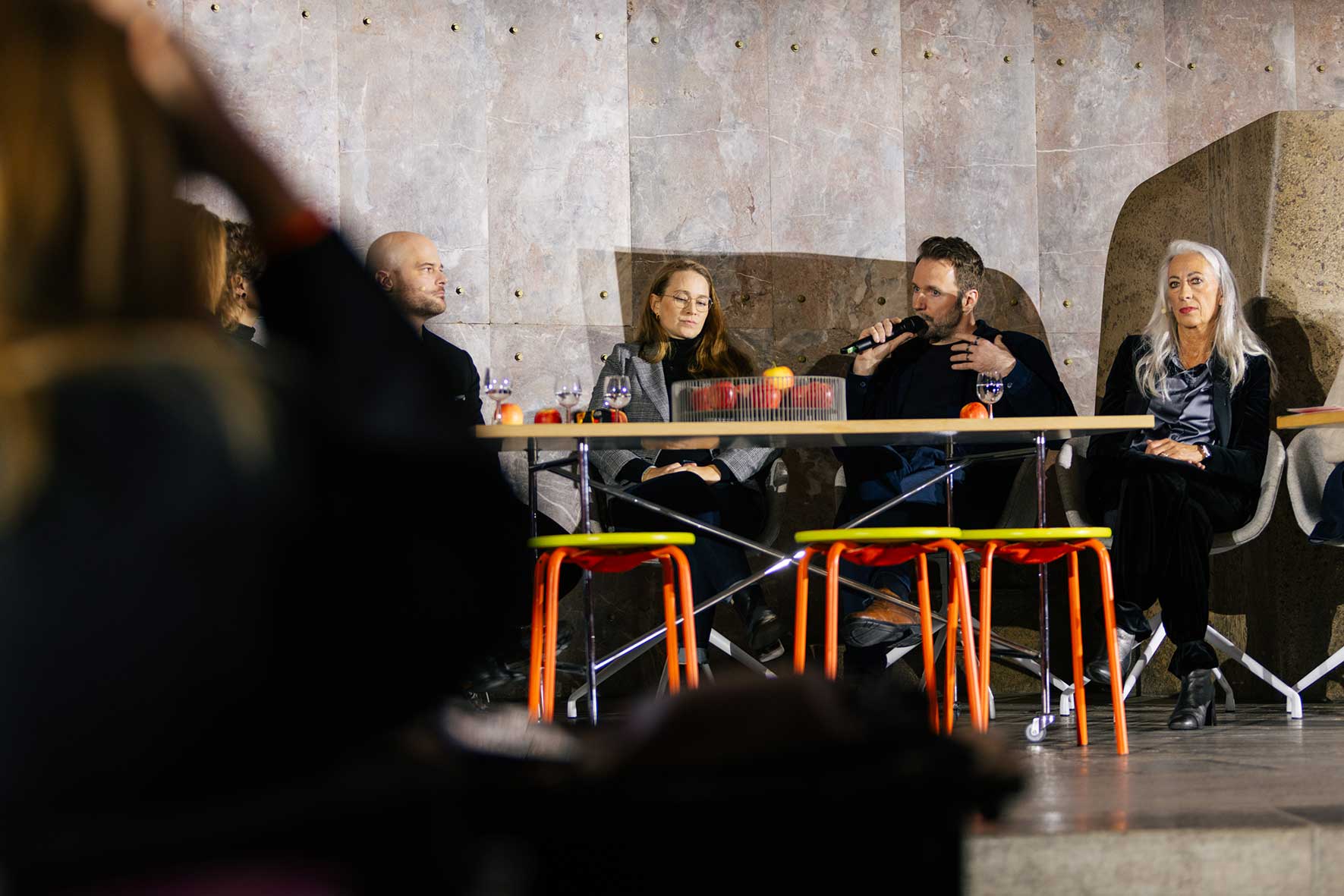 Panelists at Paulskirche, amongst others: Felix Kosok, Svenja Bickert-Appleby, Tom Bieling and Caroline Romahn. (Photo: Ben Kuhlmann).
The panel discussions brought together prominent voices from the design and cultural sectors, academia and public institutions. Among the speakers were Prof. Roland Lambrette, Carolina Romahn, Prof. Dr. Felix Kosok, Prof. Matthias Wagner K., Prof. Dr. Tom Bieling, Dr. Ina Hartwig, Barbara Lersch, Prof. Birgit Mager, Dr. Anke Gründel, Svenja Bickert-Appleby and Rebecca C. Schmidt. Their contributions addressed the connections between design, democracy, culture and societal transformation, highlighting different perspectives on how design can help shape public life.
An additional impulse came from a video presentation by transformation researcher Maja Göpel, who shared insights into the challenges and dynamics of societal change. Based on a quote by Bruce Mau (“Once you start caring, you start designing. Once you start sharing, you start multiplying”), her contribution added a broader perspective to the discussions on the role of collective action, new forms of collaboration and the development of future-oriented solutions.
The assembly also welcomed Hessian Minister for Economic Affairs Kaweh Mansoori and representatives of the international design network World Design Organization (WDO). Their participation highlighted the international dimension of the event and the importance of connecting regional initiatives with global developments in design.
One of the day’s highlights was the ceremonial handover of the World Design Capital title to Busan, South Korea, which will host the designation in 2028. The ceremony marked the conclusion of Frankfurt RheinMain’s year as World Design Capital and the beginning of a new chapter for the international design community. It also continued a tradition of international exchange, in which each host region contributes its own experiences, ideas and approaches to the global conversation about design.
With the proposed Design Action Plan, Frankfurt RheinMain now has the opportunity to build on the momentum of its World Design Capital year. The ambition is to make design a permanent part of how the region addresses social, political and urban challenges – and to ensure that the ideas developed throughout 2026 continue to shape its future.