March 18th, 2026
Children’s Books as Mirrors of Their Time
Children’s books are among the earliest cultural experiences people encounter– often long before they can read on their own. Picture books shape ideas about the world, language, imagination and not least social interaction. For this reason, they are no longer viewed solely through a pedagogical or literary lens but have become a significant field of research. In disciplines such as literary studies, art history, cultural studies and design research, children’s books are examined as complex cultural artefacts in which the social values, visual languages, and educational ideals of a particular era become visible.
Against this background, the 70th International Children’s Book Exhibition at the Klingspor Museum gains particular relevance. Its finissage (Sunday, 15 March) functioned less as a formal closing event than as a condensed journey through time: seven decades of picture-book history presented across the museum’s galleries—from the post-war period to the present day. Moving through the exhibition meant moving along a cultural timeline in which not only aesthetic developments but also broader social transformations could be traced.
To mark the anniversary, the museum (continuing its annual tradition) presented around 150 carefully selected new publications from different countries. At the same time, the exhibition invited visitors to look back: to classics, unusual or curious examples, and books that today appear almost as cultural documents. During the finissage tour, the curators Dorothee Ader and Stephanie Ehret-Pohl guided visitors through this history of the picture book. They referred to well-known classics, such as works by Janosch or Leo Lionni, but also introduced new and sometimes still little-known publications, including titles from outside the German-speaking world. This international perspective highlighted the diversity and experimental spirit that characterise contemporary children’s books.
Representing seventy years of publishing history, however, means more than simply tracing stylistic developments. Certainly, the exhibition made visible various graphic trends and aesthetic shifts, changes in illustration or typographic styles, and different approaches in book design.
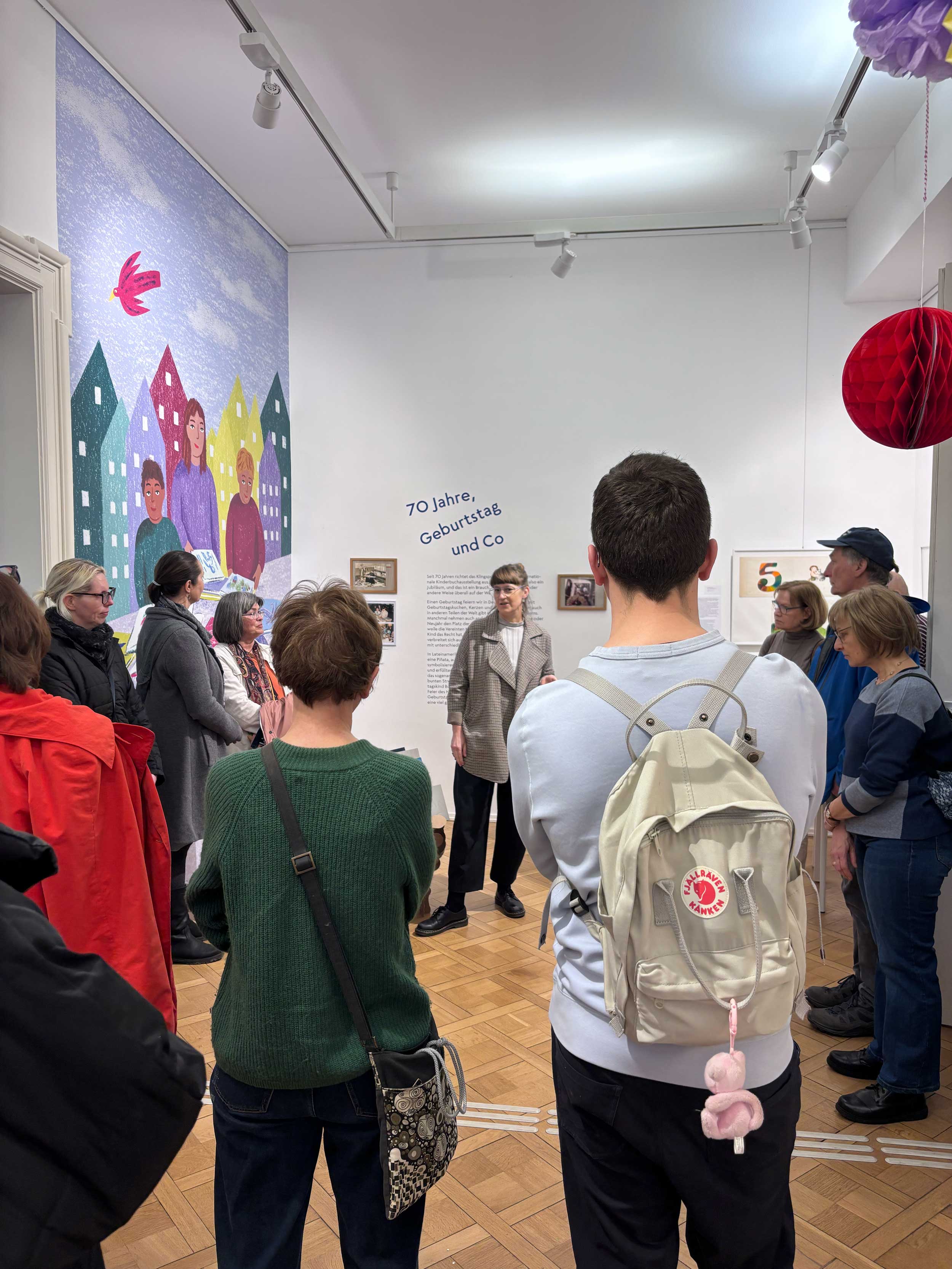 Dr. Dorothee Ader (centre) gives a guided tour of the exhibition
At the same time, children’s books clearly function as mirrors of their societies. The themes they address often reveal what concerns a particular historical moment. In the 1950s, books frequently depicted an idealised world with clearly defined social roles and moral certainties. From the 1970s onward, however, the thematic spectrum expanded significantly. Progressive publishers began to introduce more critical perspectives, acknowledging children’s experiences and addressing social issues more directly.
Across the decades, shifting thematic priorities become visible: education, equality, identity, role models, the environment, politics, war, or migration. Children’s books translate complex societal debates into narratives accessible to young readers, offering ways of understanding the world through a child’s perspective. In recent years especially, emancipatory movements have left a strong imprint on children’s publishing. Traditional role models are increasingly questioned, diversity is more widely represented, and many books encourage children to appreciate their bodies, identities, and individual abilities.
Beyond themes and imagery, the books also reflect technological developments. Advances in printing processes, digital illustration tools, and layout software have profoundly changed how picture books are produced. Techniques such as digital cutting and digital image editing now expand the creative possibilities for illustrators, designers and publishers. These technological shifts also influence the visual language of contemporary books.
The direct juxtaposition of older and newer works made it particularly clear how much the picture book has evolved over time, and yet how vibrant the form remains. Between classics, curious historical examples, and recent international publications, the exhibition ultimately presented a panorama showing that the children’s book is far more than children’s entertainment. It is a cultural archive and a sensitive seismograph of social change.