May 27th, 2026
(Still) rembering Michael Erlhoff
Today, Michael Erlhoff would have turned 80 years old. As a design theorist, author and influential voice in the discourse on design culture, he helped shape how design is understood (not least as intellectual practice). Much of what he left behind continues to live on in the people he taught, worked with and inspired. His ideas remain present in ongoing discussions about design theory, critical practice, and the role of design in society. So that even today, his contributions continue to resonate—quietly but persistently—wherever design is taken seriously as a field of thought as well as practice. Today we want to shed light on some (out of so many) books by and about Erlhoff.
With the novel “Musils Mulis” (König 2021), the edited volume “Design & Democracy” (BIRD / Birkhäuser 2021), and the collection of essays “Im Schatten von Design” (Bauwelt Fundamente / Birkhäuser 2021), three books were published in the year, Erlhoff passed away (2021). His absence is still deeply felt, yet reading his work can offer partial consolation. His writings deal not only with the joyful aspects of design, but also with its deviant, daring, and dark sides.
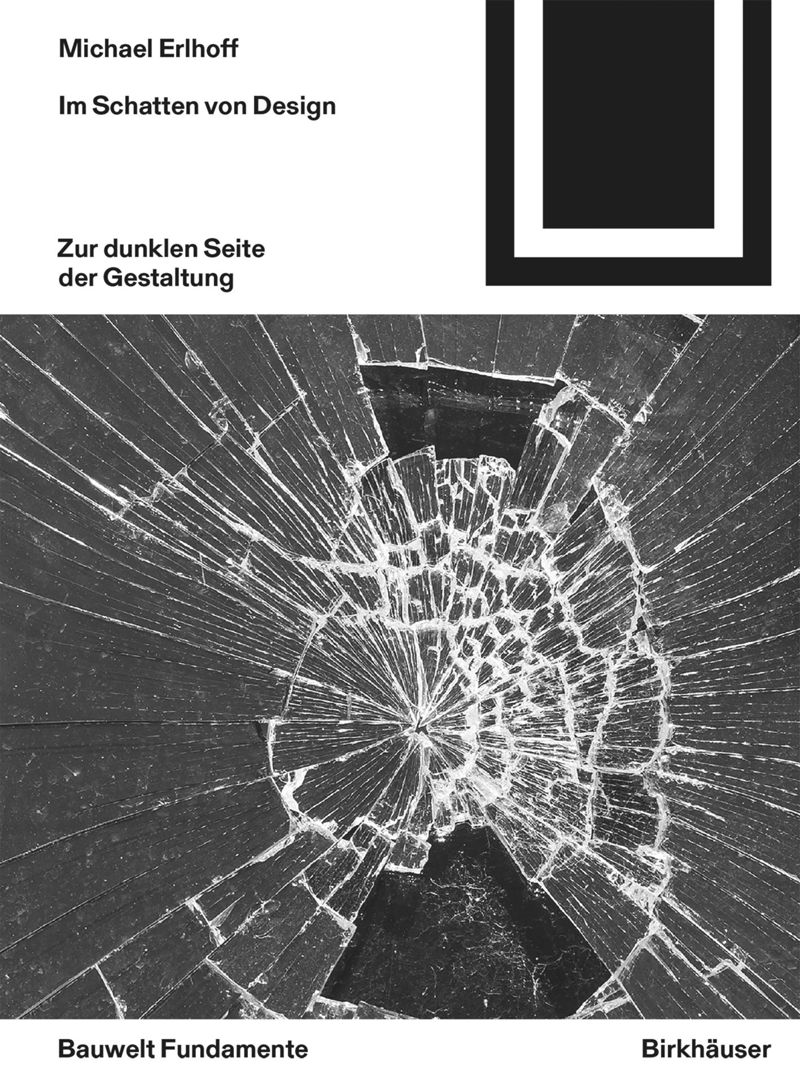
In the Shadow of Design
Design is by no means always good, and it certainly does not always do good. Like, presumably, all of us, it also has its dark sides. In his book “Im Schatten von Design – Zur dunklen Seite der Gestaltung” (Birkhäuser 2021), published shortly before his death, Erlhoff draws attention to weapons, execution devices, National Socialism, and the designers associated with them. The book is structured into six main themes, each consisting of short, concise essay collections.
In the opening lines of the chapter “Perfect Design”, Erlhoff outlines the basic criteria for “good” and “successful” design, immediately followed by an example that is striking in its implications: in a 1999 American television documentary, Fred A. Leuchter proudly presented a technical object he had designed, evaluated according to the criteria Erlhoff describes. The object in question is the electric chair. It operates quickly and precisely and, most importantly, ensures a “comfortable” execution for its users. Leuchter, seemingly a master in his field, had already been involved years earlier in the redesign of gas chambers. He later gained notoriety as a Holocaust denier.
In the chapter “Aestheticization and Normalization of Everyday Life”, Erlhoff explains how many Bauhaus members, including Herbert Bayer, Walter Gropius, Mies van der Rohe, and many other designers, actively worked for the National Socialist regime. After the Second World War, none of them faced consequences. Things were ignored and forgotten, and even when legal action was taken, as in the case of Fritz Ertl—who was involved in the construction and expansion of concentration camps—the charges were simply dropped. This was likely due not least to the success of the “Bauhaus” brand.
Erlhoff demonstrates that design does not only have beautiful sides, as seen in branding, fashion, graphic design, and architecture. It also harbors dark dimensions in its shadow: war, terrorism, fascism, and much more. The book is essential reading for teachers, students, designers, and anyone interested in understanding the broad spectrum in which designers operate – even if not always in the service of “the good.”
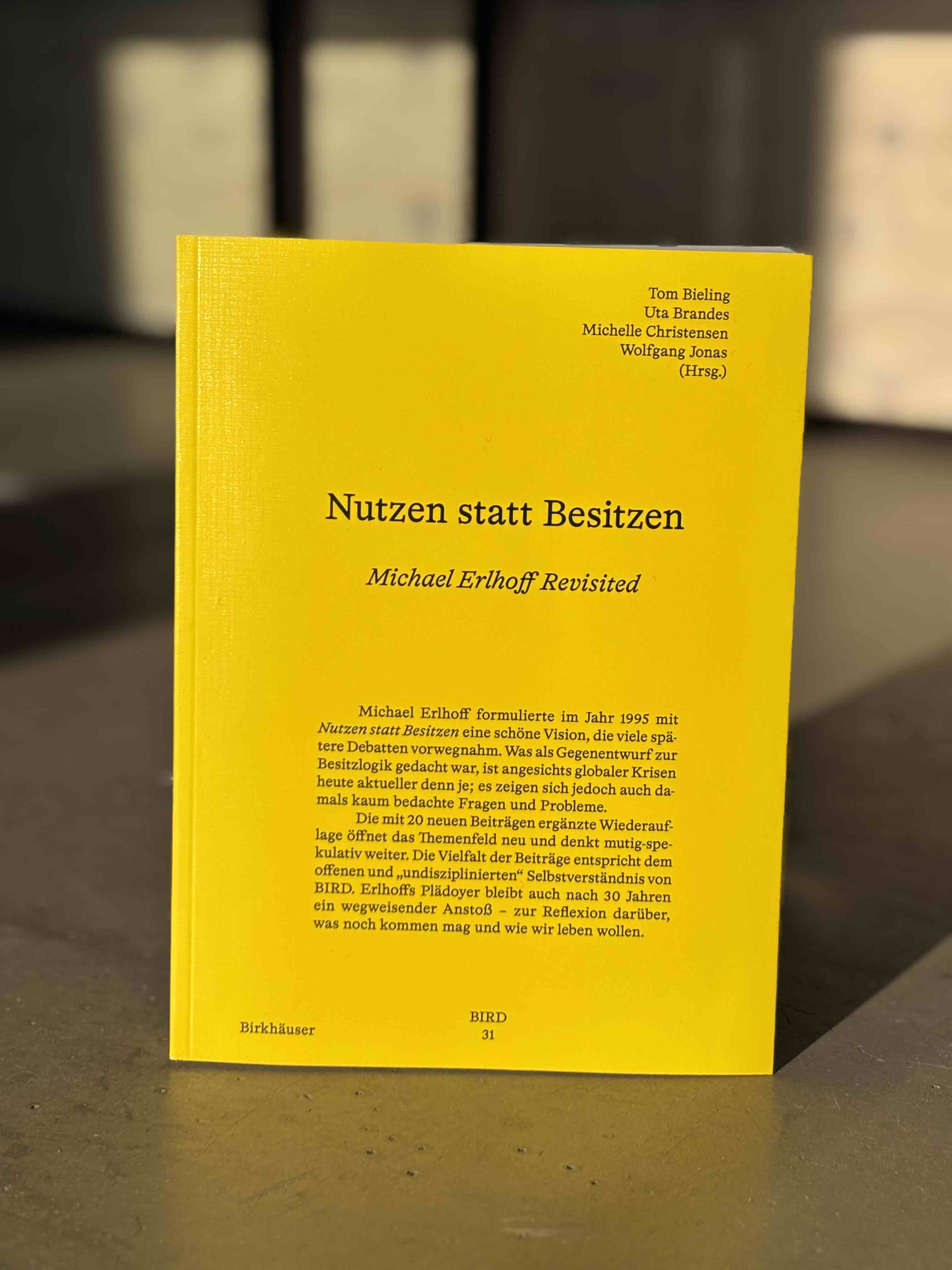
Use instead of own
When Erlhoff published his programmatic book “Nutzen statt Besitzen” (“Use Instead of Owning”) in 1995, it was a plea for a different, more rational form of economy and coexistence – economically, ecologically, and socially. The idea was simple yet far-reaching: things do not need to belong to us in order to serve us; shared use can make us richer than private ownership. Thirty years later, much of what once sounded visionary has become lived reality: car sharing, bike rental systems, co-working spaces, streaming services. Yet at the same time, it has become clear that the ideal of sharing has itself long since turned into a business model – with all its contradictions and darker sides.
Thirty years after the original publication and in the twentieth year of its existence, BIRD (Board of International Research in Design), of which Erlhoff was a co-founder, has republished the text – now expanded with contemporary perspectives on the topic. Twenty new essays by authors from design, theory, art, philosophy, mobility research, and cultural studies critically, thoughtfully, and forward-looking continue the central idea. This is not a nostalgic retrospective, but a vibrant, experimental space for thinking about how we want to deal with objects, resources, and knowledge in a globalized, digital world.
Wolfgang Jonas, who introduces the new edition, describes the development precisely: the idea of “use instead of owning” is more relevant than ever today, but at the same time infinitely more complex. Sharing is no longer a pure counter-model to ownership; rather, it is often itself an expression of consumerist logic – one that can be ecologically and socially problematic and highly product-intensive. Jonas proposes updating Erlhoff’s approach: making it critical of economic systems of exploitation, situating it within technological and societal transformations, and bold enough to imagine new forms of the common good, the commons, and immaterial forms of ownership.
The polyphony of contributions is no coincidence but reflects BIRD’s self-understanding as an “undisciplined” research context. Practice, theory, and speculation meet on equal footing. The essays argue, narrate, experiment, and contradict one another – and precisely through this emerges a rich, tension-filled discourse showing that the question “use or own?” today extends far beyond economic or ecological categories. It touches on our understanding of ourselves as social, technical, and political beings.
Contributors include Tom Bieling, Uta Brandes, Katharina Bredies, Rosan Chow, Michelle Christensen, Florian Conradi, Peter Eckart, Meret Ernst, Köbi Gantenbein, Simon Grand, Angela Grosso Ciponte, Harald Gründl, Saskia Hebert, Wolfgang Jonas, Simon Küffer, Eileen Mandir, Ralf Michel, Hans-Ulrich Reck, Stephan Rammler, Evelyne Roth, Erik Spiekermann, Peter Stephan, Kai Vöckler, Thomas Wagner, and Tina Weisser.
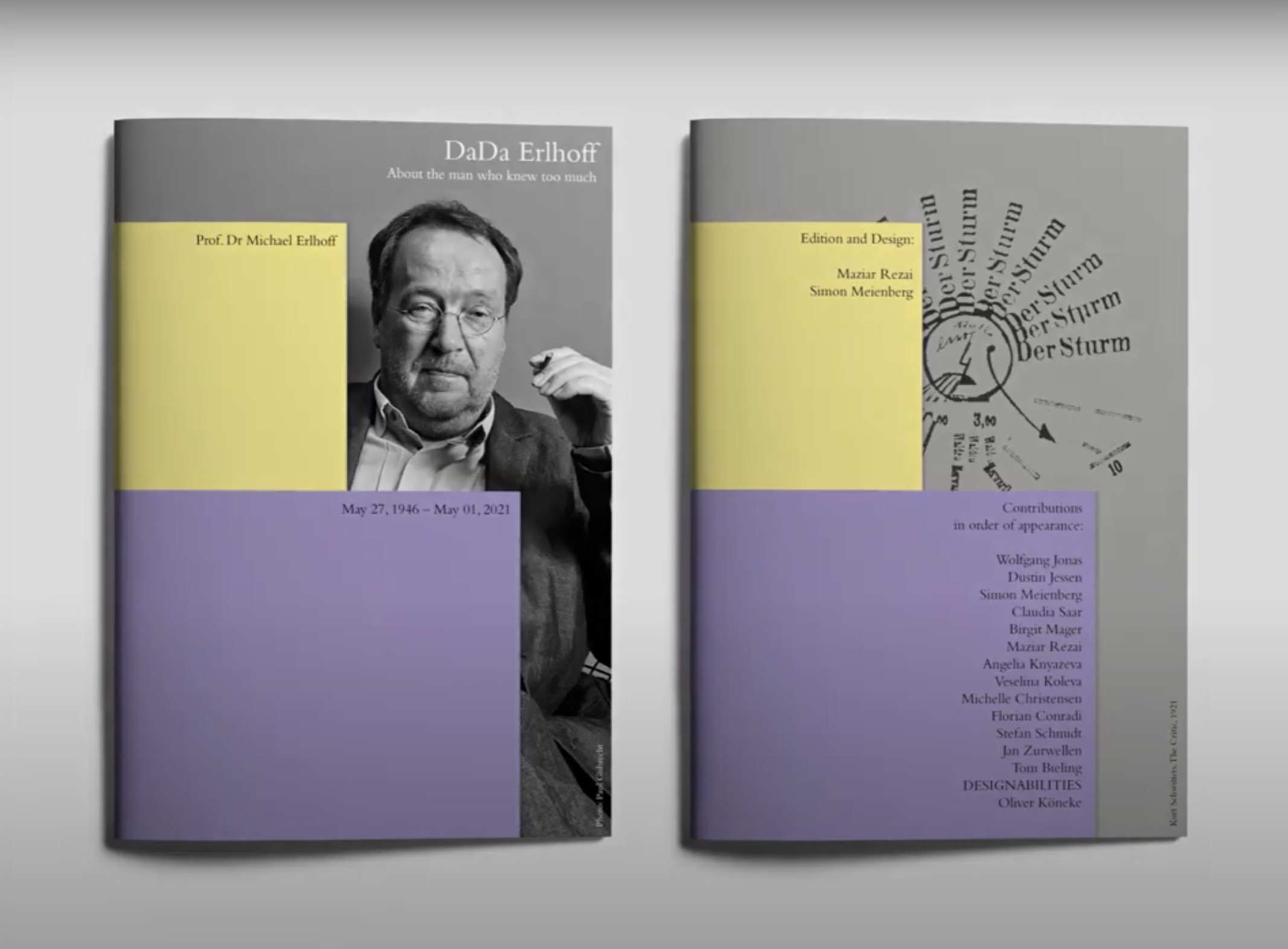
The Man Who Knew Too Much
Michael Erlhoff leaves behind a legacy that is less about objects and more about how we understand design itself — its reach, its responsibility and its blind spots. One of his most influential contributions (together with Uta Brandes) was the idea of non-intentional design: the recognition that not only deliberately designed products shape our world, but also systems, behaviors, infrastructures, and social arrangements that were never consciously “designed” as such—yet still profoundly affect how we live. This perspective helped shift design discourse toward accountability for the unintended and the implicit.
As a long-time educator and co-founder of the Köln International School of Design (KISD), he also helped shape generations of designers who were encouraged to think critically, interdisciplinarily and socially. In this sense, Erlhoff’s legacy is a widening of responsibility. It is a reminder that design does not begin with intention and does not end with use. It continues in interpretation, in unintended effects, and in the structures that quietly shape behavior. What remains is a way of thinking: attentive, critical, and open to the uncomfortable insight that even what is not “designed” still demands design awareness.
The Festschrift “DaDa Erlhoff: About The Man Who Knew Too Much”, edited by Maziar Rezai and Simon Meienberg in memory of Prof. Dr. Michael Erlhoff was published in 2022. The booklet, which contains contributions by Wolfgang Jonas, Tom Bieling, Dustin Jessen, Simon Meienberg, Claudia Saar, Birgit Mager, Maziar Rezai, Veselina Koleva, Angelia Knyazeva, Michelle Christensen, Florian Conradi, Stefan Schmidt, Jan Zurwellen and DESIGNABILITIES, is also available as a preview PDF.
References
The part on Erlhoffs "Im Schatten von Design" is basically a translated version of Ilgün, Burca (2022): Zur dunklen Seite der Gestaltung | Buchbesprechung. In: DESIGNABILITIES Design Research Journal, (05) 2022. https://tinyurl.com/2a622kfj ISSN 2511-6274